Your family and the health of the pet should not be compromised to protect your home against the pests. Most of the conventional pesticides are harsh as they might be left with toxic remains within living areas. The Eco-Friendly Pest Control techniques are the methods that today are being adopted by more homeowners as they are effective in pest management and it gives greater control of pests without endangering the living environment of children, pets and the environment.
This guide describes the mode of action of natural and low-toxicity pest solutions, the kinds of pests they manage best, and the ways families can use less harmful practices to manage the pests without losing effectiveness.
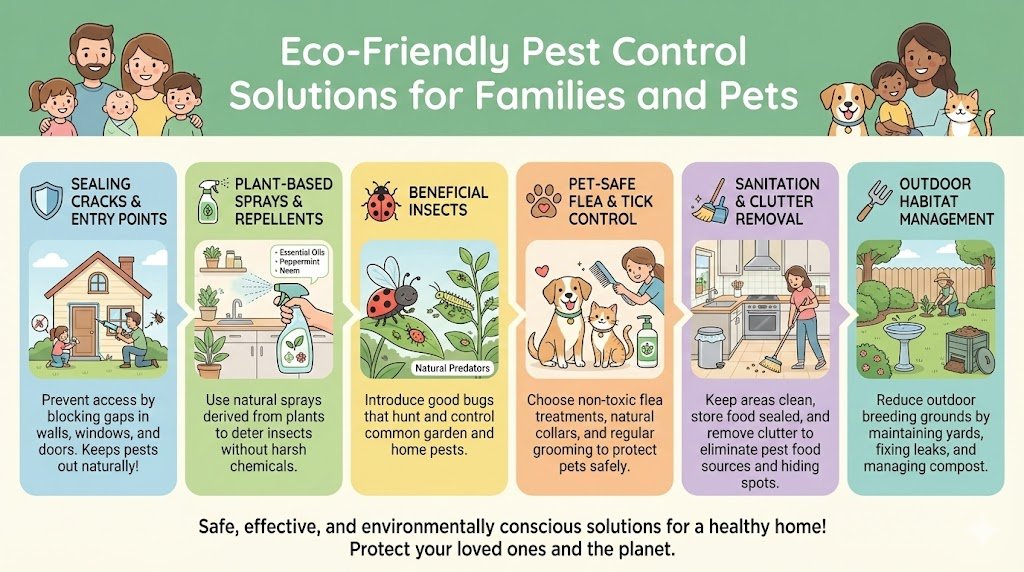
The reason why families are moving towards the more secure pest solutions.
Children and pets have a higher amount of time near the floor, base board and outdoor play areas, which are precisely the areas where pest treatments are commonly used. Traditional chemical sprays tend to remain covered with remnants which could either be inhaled or taken in through skin contacts.
This is the reason why Eco-Friendly Pest Control is playing out to be the favorite among the households. These methods aim at prevention, therapy-specific treatments and products that have low impacts that lower unnecessary exposure to chemicals.
Key benefits include:
- Reduced health risks
- Safer indoor air quality
- Lower environmental impact
- Long-term pest prevention
Why is pest control environmentally friendly?
Principles of the Integrated Pest Management (IPM) lead to eco-friendly pest management. IPM avoids the use of chemicals alone and employs various methods that can be used to control the pests at their inception.
More common eco-based policies are:
- Obstacles and methods of exclusion.
- Hygiene and water management.
- Habitat modification
- Specific biological or botanical therapy.
It is aimed not only to kill the pests-but to avoid recurrence of the infestations.
Ordinary domestic pests that can be managed without usage of chemicals.
Most common pests are sensitive to non-toxic practices, such as:
- Ants
- Cockroaches
- Fleas and ticks
- Mosquitoes
- Spiders
- Rodents
Eco-Friendly Pest Control methods have the potential to be as effective as the usual methods of treatment of these pests when appropriately applied.
Plant-based and botanical medicines.
The pesticides that are prepared by using botanical sources are natural like essential oils and plant extracts. The most used active ingredients include peppermint, rosemary, thyme, cedarwood and clove oil.
These treatments:
- Interfere with insect brains.
- Send the pests away, discrimination free.
- Rapidly decomposes in the environment.
They are normally applied on ants, flies, roaches and mosquitoes.
Positive insects and biological control.
Biological pest control involves the introduction of the predators that would control the pests. Outside areas and gardens may include:
- Aphid control by lady beetles.
- Soil-dwelling pests Nematodes.
Biological solutions enable the preservation of ecological balance and minimize the possibility of using chemicals.
The exclusion and structural sealing.
The simplest method of pests management is by keeping them off.
Professional sealing services are specialized in:
- Wounds and fissures around doors and windows.
- Foundation gaps
- Utility entry points
- Damaged screens and vents
Homeowners must greatly reduce the efforts of repeated treatments by preventing access routes. This is a prevention method, which forms a basis of Eco-Friendly Pest Control.
Physical removals and trap.
Pest management that involves low toxicity involves:
- Sticky traps
- Mechanical rodent traps
- Light-based insect traps
These gadgets assist in keeping a check on activity as well as keeping the number of pests under control without placing chemicals inside the home.
Sanitation and humidity control.
Moisture, food debris and clutter attract many pests.
Pest control schemes that are environmentally friendly aim at:
- Repairing leaking pipes
- Increasing drainage and ventilation.
- Securing food storage
- Removing outdoor debris
Spraying should be avoided and the environmental conditions may be controlled sometimes.
Flea and tick products that are pet friendly.
In families that keep pets, the issue of flea and tick control is of great concern.
Natural options include:
- Vital oil-sprays made up of animals.
- Outdoor applications Diatomaceous Earth.
- Frequency of cleaning of pets and bedding (vacuuming).
Care should be taken to consult a veterinarian before applying any topical treatments on animals.
Comparison Table – Traditional vs Eco-Friendly Pest Control
| Feature | Traditional Pest Control | Eco-Friendly Pest Control |
| Chemical exposure | High | Low |
| Residue in living areas | Often present | Minimal |
| Pet and child safety | Moderate concern | High priority |
| Environmental impact | Higher | Lower |
| Prevention focus | Limited | Strong |
Is the use of environmentally friendly pests effective?
Eco-Friendly Pest Control programs can bring success in the long run when implemented correctly. The major distinction is that eco approaches are concerned with prevention and behavioural change as compared to short term extermination.
Services that are eco-based and usually belonging to professionals encompass:
- Detailed inspection
- Customized treatment plans
- Follow-ups and follow-ups.
- Homeowner education: prevention.
The method produces sustainable pest management outcomes without the excessive application of chemicals.
Family advice on the use of eco pest management at home.
- Pet food to be stored in capped containers.
- Clean spills immediately
- Do away with standing water out of doors.
- Cut shrubs near the walls.
- Conduct periodic inspections.
Such practices go a long way in discouraging attraction of pests.
For the fast, effective, and eco-friendly pest control service, contact koalatyService
Final Thought (Conclusion)
It is not just the avoidance of pests that make the home a healthy living environment; it also entails the safety of the people and animals residing in the home. With the use of Eco-Friendly Pest Control, families receive an opportunity to manage infestations successfully with reducing the risk of contact with harmful chemicals. Through effective prevention and prudent monitoring, sustainable pest control will be a safer and more sustainable approach to securing your house in the long run.
FAQs
Is eco-friendly pest control safe for children and pets?
Yes. It uses low-toxicity and targeted methods designed to reduce exposure risks.
Does eco pest control work as well as chemical treatments?
Yes, especially when prevention and exclusion strategies are used consistently.
How often should eco-friendly treatments be applied?
It depends on pest activity and environmental conditions, but most plans use scheduled monitoring.
Can eco pest control eliminate rodents?
Yes. Exclusion, trapping, and habitat management are effective for rodent control.
Are eco pest control services more expensive?
Costs vary, but long-term prevention often reduces repeated treatment expenses.